
There is a common misconception that a basic obedience training class is the way to start life with your new puppy. Most of these classes start once a puppy has been fully vaccinated and only cover basic cues, such as sit and stay. Whilst it is important for puppies to learn these cues, and be obedient, we really want our focus to be on creating a well behaved, balanced dog who is less likely to experience behavioural problems later on in life.
Puppies are learning every minute of every day so it is really important to set your puppy up for success right from day one. The most important thing to start off with is building a positive bond between you and your puppy. You want to be a source of safety and security, and someone that your puppy trusts. We expect dogs to live in a human world, with lots of confusing and potentially frightening events: excited children, busy roads, THE HOOVER, stairs, other pets in the home, a wheelie bin, a bath! So it is really important that we introduce puppies to the world as early as possible, in a way that is positive.
Ida the Miniature Pinscher pup is getting used to a short car journey.
It is extremely important to train the behaviours so often associated with classes but from the first day that your puppy arrives at your house, the focus should be on teaching confidence, self-control and frustration tolerance in order to achieve the end goal of a well-behaved dog, who chooses to make the right choices in situations, without you having to ask them. This can all be achieved by focusing on the behaviours that we would like your puppy to do and making these really desirable. The more desirable we make a behaviour, the more your puppy will do it! Over time, these behaviours will start to come naturally.
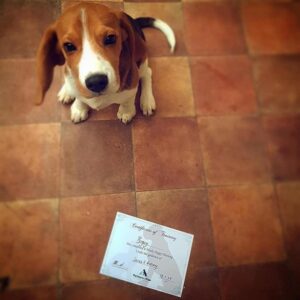


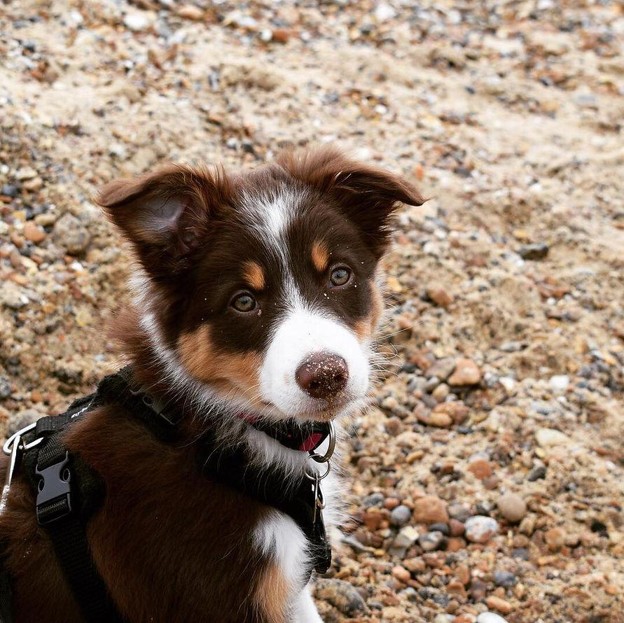
These puppies have all learned to sit patiently in a number of different situations, on the beach, when food is around and when greeting new people on a walk.
In my experience, owners who have contacted me for puppy training at home with their 8-week old puppy have progressed much faster and have found the sessions more rewarding than owners who have waited until their puppy is 16-20 weeks old. Often, this is because the slightly older puppies have had a chance to self-reward for engaging in the behaviours that owners do not find desirable, for example, digging up the garden or snatching food! That is not to say that these puppies are ‘too old’ to start training, just that you have to work a little harder against previous learning. I do not come to the house on session 1 ready to teach a dog to sit for an hour straight, instead I come ready to teach the owner the essentials to create a confident, patient and polite puppy before we even tackle the sits, stays and drops.